
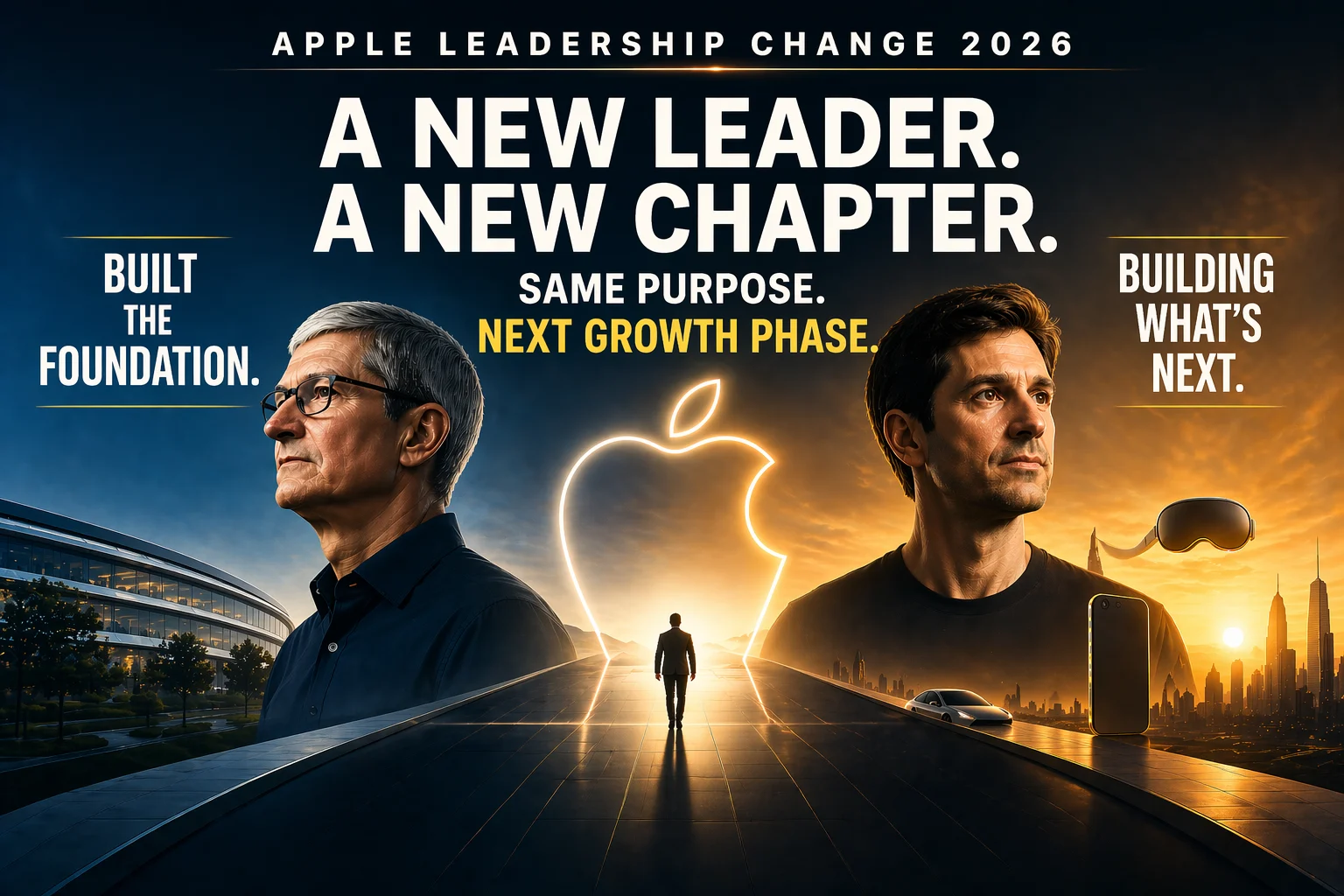
The last time Apple changed CEOs, it felt like the end of an era. Steve Jobs stepped down in 2011, and Tim Cook took over. The mood was cautious. Could Apple survive without its visionary?
Fifteen years later, Apple is not just surviving. It is sitting at the top.
Which is exactly why this new shift feels gripping.
Because this time, there is no crisis. Just a very deliberate move.
John Ternus is now stepping in as CEO, while Tim Cook moves up to Executive Chairman.
And no, this is not just a routine succession. This is Apple quietly repositioning itself.
Read more to get a clear breakdown of who John Ternus is, why Apple's leadership changed in 2026, what changes inside its power structure, and most importantly, what this means for Apple’s next phase.
From Cook to Ternus: What Actually Changed
Let’s get the timeline straight.
2011 – Tim Cook becomes CEO
April 2026 – Apple announces leadership transition
September 2026 – Ternus takes over as CEO, Cook becomes Executive Chairman
On paper, it looks clean.
But here is the real shift: Apple is moving from an operations-first CEO to a product-first CEO.
Cook scaled Apple. Ternus is expected to reshape it.
That is not a small change.
The Insider Who Was Always There
If you are wondering who Ternus is, that is kind of the point.
He is not flashy. Not controversial. Not even widely known outside Apple circles.
But internally, he has been everywhere.
Joined Apple in 2001 as part of the hardware engineering team
Became VP of Hardware Engineering in 2013
Promoted to SVP in 2021
He has worked on iPhones, Macs, and most importantly, the transition to Apple Silicon.
In short, he understands the product better than almost anyone else in the company.
Which makes him a safe choice. And also a very strategic one.
The End of the Cook Era, or Is It?
Let’s be clear. Cook is not really going anywhere.
As Tim Cook will be the executive chairman, he still holds serious influence.
Board decisions. Global strategy. Policy. All still in his orbit.
But his run as CEO is worth pausing on.
From 2011 to 2026, Apple’s valuation went from roughly $350 billion to over $4 trillion. The Reason?
When Tim Cook joined Apple in 1998 as Senior Vice President of Operations, the company was still recovering from financial instability.
He did not start with products. He fixed the machine behind them.
Cook streamlined Apple’s supply chain, reduced inventory drastically, and shifted manufacturing to a more efficient global model.
By the time he became CEO in 2011, the systems to support massive growth were already in place.
He turned Apple into a services giant and made the company financially untouchable.
So why step aside now?
Because peak performance is the best time to change direction.
Back then, Apple needed stability. Now, it needs reinvention.
This Isn’t Just Succession. It’s a Reset
Here is where things get interesting.
Apple’s leadership change is happening at a very specific moment.
Apple is no longer fighting for dominance. It already has it. Now it is fighting for relevance in the next phase.
AI. Mixed reality. Next-gen hardware.
And let’s be honest, Apple has not exactly been leading the AI conversation.
So what do you do?
You put a hardware-first leader in charge.
Someone who can integrate AI into products, not just talk about it.
That is where Ternus fits in.
And while Apple is still setting its AI direction, companies like Google are already embedding it into everyday tools. Read also, how Gemini in Maps shows what that shift actually looks like.
Why the Timing Isn’t a Coincidence
This did not come together overnight. Which makes the timing less surprising and more intentional.
Apple tends to move when three things align. Internal readiness, market pressure, and a clear next phase of growth. That alignment is what you are seeing now.
At the same time, AI is accelerating, and competition is tightening. But this shift is not a reaction to those changes. It is Apple positioning itself ahead of them.
John Ternus has been in the pipeline for years. His rise through hardware leadership was not subtle, and neither is his appointment now.
So instead of asking why now, the better question is this: Why has Apple been preparing for this moment?
Because when a company like Apple makes a move this clean, it usually means the next phase is already mapped out.
And if you think leadership shifts are subtle, wait till you see how brands themselves are quietly reshaping industries. Our take on Sony’s TV exit breaks that down.