
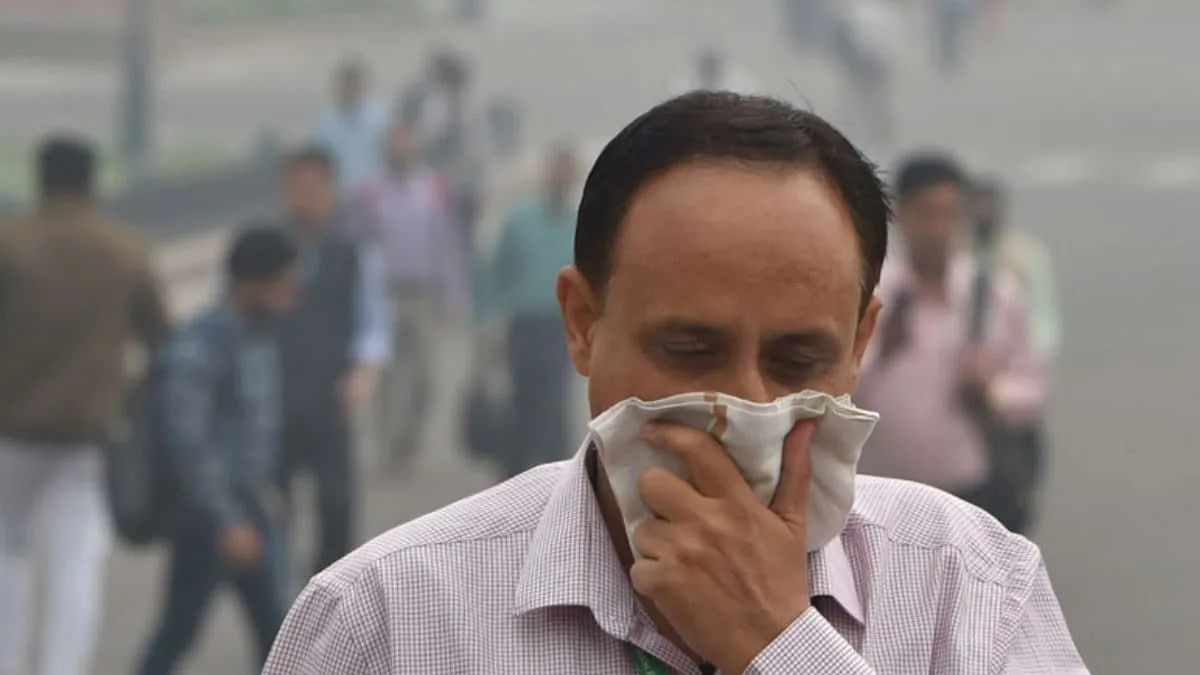
The national capital's air quality has reached a critical level. According to the Central Pollution Control Board (CPCB), Delhi's total Air Quality Index (AQI) increased to 391 early on Sunday morning, firmly placing the city in the "Severe" category.
AQI levels above 400 were reported in a number of important places, indicating dangerous conditions and posing urgent public health issues.
What the Data Shows ?
Delhi's total AQI was 391 at 7 a.m., the lowest of the season.
Bawana registered 436, R.K. Puram 422, Patparganj 425, and Chandni Chowk 409, all of which exceeded the "Severe" level.
The AQI slightly improved in the afternoon, but it was still in the "Very Poor" category at 370-380.
Noida, Ghaziabad, and Greater Noida, three nearby NCR areas, with AQIs between 300 and 354, which is still considered "Very Poor."
Why Is This Going On?
Delhi's air turns into a poisonous mixture of pollutants once winter arrives because of:
Pollutants are trapped close to the ground by low wind velocity and temperature inversion.
Industrial pollution, construction dust, and vehicle emissions.
In nearby states like Punjab and Haryana, crop stubble is burning, contributing to the haze in Delhi.
Particulate matter levels are exacerbated by firecracker leftovers and home heating.
The city is now completely covered in a thick layer of smog, which has a negative effect on public health and visibility.
Health and Safety Guidance
As pollution levels approach dangerously high levels, authorities have advised locals to take precautions:
Stay clear of outdoor activities, particularly in the early morning and late at night.
When you go outside, put on a N95 or N99 mask.
To avoid indoor pollution, keep doors and windows closed.
To lessen the impact of poisonous air, use air filters and drink plenty of water.
Refrain from utilizing private automobiles excessively or burning garbage.
Government Action & Reaction
After considering the circumstances, the Commission for Air Quality Management (CAQM) decided not to apply the Graded Response Action Plan's (GRAP) Stage 3 limits just yet. Stages 1 and 2 measures, like reducing construction dust, restricting car mobility, and encouraging public transportation, are still in effect.