
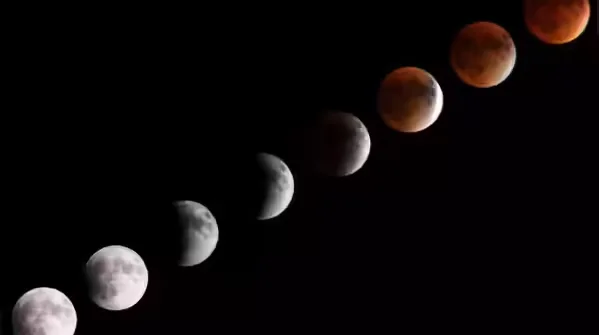
On March 3, 2026, the first Chandra Grahan (Lunar Eclipse) of the year will light up the evening sky. While the eclipse will be brief in many parts of India, it remains a celestial event worth watching, especially for sky enthusiasts and curious observers.
If you’re wondering whether you’ll be able to see it, what a “Blood Moon” means, or whether it’s safe to watch, here’s everything explained clearly.
When Is the March 3 Lunar Eclipse?
The total lunar eclipse will occur on March 3, 2026.
Timings in India (IST)
According to publicly available data from Time and Date:
Penumbral phase begins: 4:58 PM IST
Totality starts: 4:58 PM IST
Totality ends: 5:32 PM IST
Penumbral phase concludes: 7:53 PM IST
Because the Moon rises during the eclipse in many parts of India, visibility will vary depending on your location.
Will the Full Eclipse Be Visible in India?
The total lunar eclipse will occur on March 3, 2026.
Timings in India (IST)
According to publicly available data from Time and Date:
Penumbral phase begins: 4:58 PM IST
Totality starts: 4:58 PM IST
Totality ends: 5:32 PM IST
Penumbral phase concludes: 7:53 PM IST
Because the Moon rises during the eclipse in many parts of India, visibility will vary depending on your location.
Will the Full Eclipse Be Visible in India?
Not anywhere. Only the eclipse's final phase, which occurs mostly around sunset, will be visible in the majority of India. The duration of the viewable window could be around 20 minutes.
Nonetheless, a number of Northeastern cities are anticipated to experience totality with 100% obscuration, including:
Assam's Dibrugarh
Assam's Dispur
Assam's Guwahati
Arunachal Pradesh's Itanagar
Meghalaya's Shillong
As the Moon rises, it will already be partially shadowed in many other places.
Why Is It Called a “Blood Moon”?
The Earth passes between the Sun and the Moon during a total lunar eclipse, obstructing direct sunlight. Earth's atmosphere is the only source of light that reaches the Moon.
The Moon is commonly referred to as a Blood Moon because of the way this filtered light bends and scatters, giving it a crimson or deep orange hue.